May 8, 2026 - 5 min read
Most AI Programs Are Just for Show
Last quarter, a CEO I know stood up at the all-hands and announced the company's "AI transformation." Cool slide deck. Press release. LinkedIn buzz. Six months later, the...
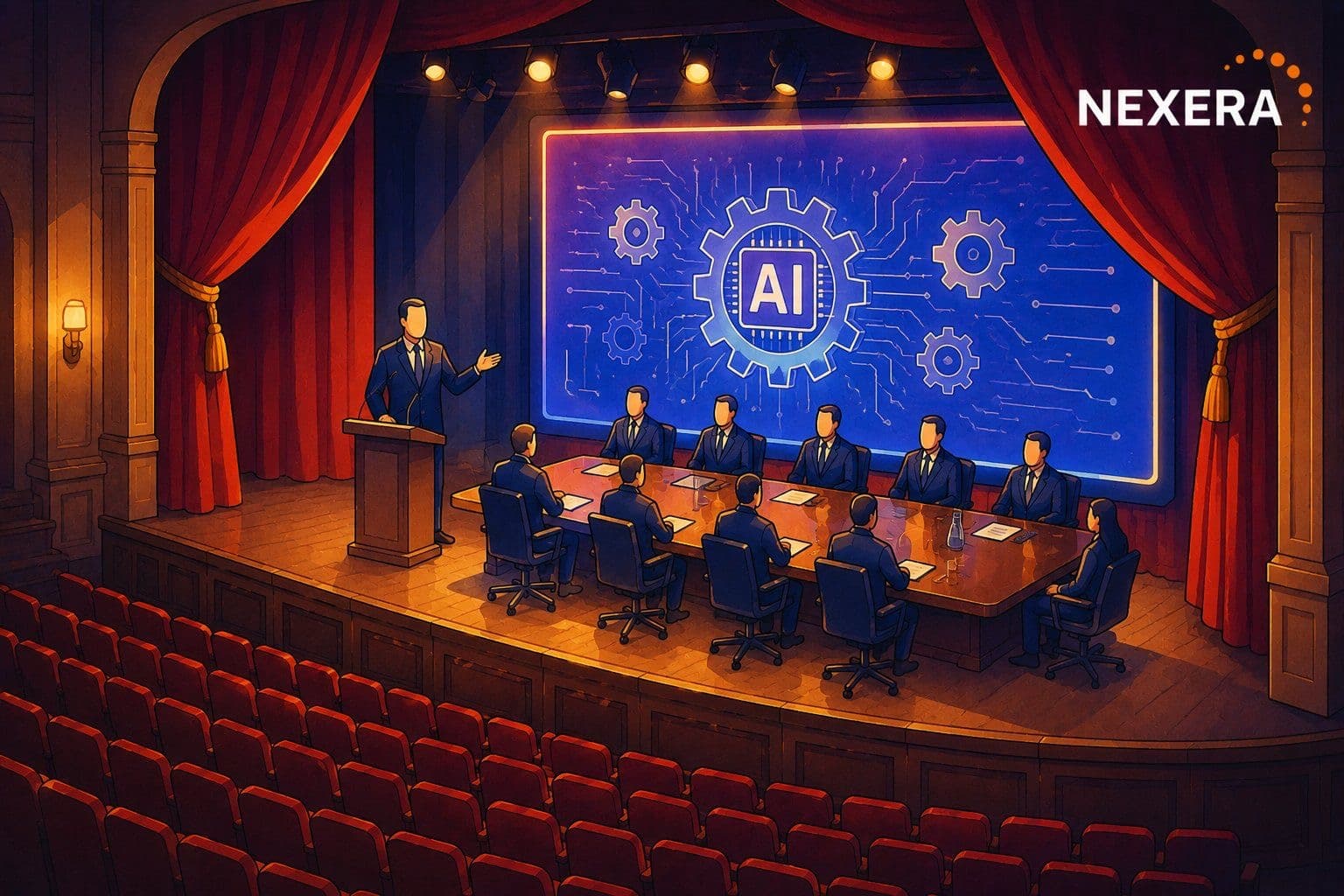
Last quarter, a CEO I know stood up at the all-hands and announced the company's "AI transformation." Cool slide deck. Press release. LinkedIn buzz. Six months later, the operations team is doing things exactly the way they did in 2024.
That is not a story. That is a pattern.
Nexera spends most of its time inside small and mid-sized businesses, the ones with somewhere between 20 and 500 employees. And what we keep seeing, in different versions, is the same disconnect: the leadership team is convinced they are "doing AI." The frontline team has no idea what that means.
The numbers back this up. A recent industry survey found that 75% of executives admit their company's AI strategy is "more for show" than actual internal guidance. Forty-eight percent now describe AI adoption as a massive disappointment, up from 34% the year before. Only about a quarter report meaningful ROI from generative AI or AI agents.
Translation: most companies have adopted the look of AI without the work of it.
What AI Theater Actually Looks Like
You do not have to look hard to spot it. The signs are loud once you know what you are looking at.
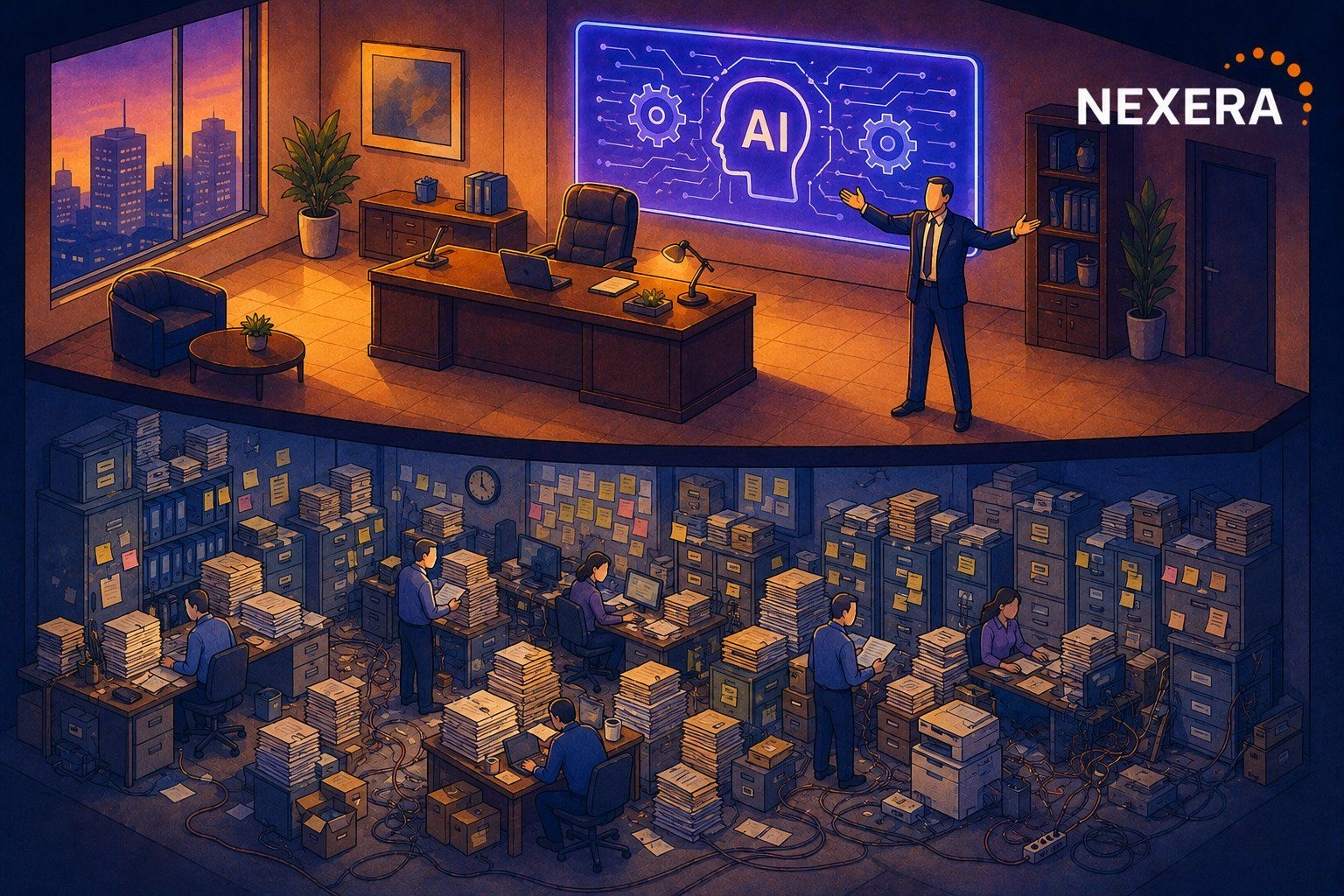
There is the executive deck nobody on the team has seen. There is the new Slack channel called "ai-experiments" that has not had a message in three months. There is the ChatGPT enterprise license that 12 people actually log into. There is the announcement that ends with "we are committed to AI-first operations" and no follow-up email about what that means in practice.
Theater AI is loud at the top and silent at the bottom. Real AI is quiet at the top and loud at the bottom.
Why Companies End Up Here
Nobody starts with the goal of fake adoption. The path there is usually well-intentioned.
The board asks what the AI strategy is, so the C-suite needs an answer. The competitor announces an AI initiative, so a counter-announcement goes out. A consultant runs a workshop and the deliverable is a roadmap nobody in operations co-signed. Everyone agrees AI is important. Almost no one is responsible for actually putting it into the work.
This pattern shows up everywhere, but it tends to be worse in mid-market firms because the gap between leadership and frontline is short enough to fake. In a 50-person company, the CEO can claim AI adoption is happening because he sees a few people using ChatGPT in the lunchroom. That is not adoption. That is coincidence.
What the Quiet 25% Do Differently
The companies actually getting ROI from AI look almost boring from the outside. They do not have a big "AI strategy." They have a list of friction points.

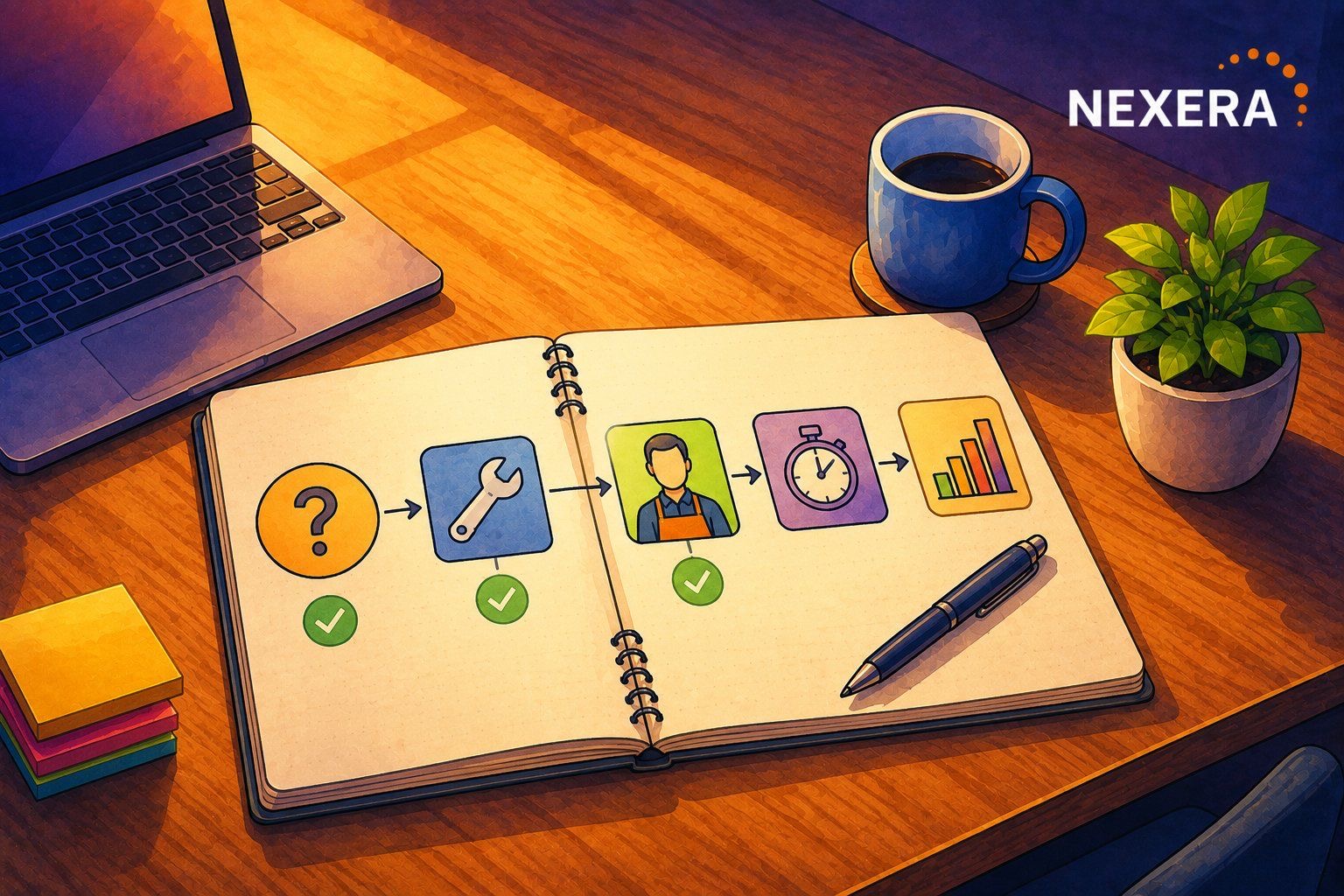
Their CFO says, "We close the books in 11 days. I want it down to 5." Their head of sales says, "Our SDRs spend 4 hours a week building call lists. Cut that." Their CS lead says, "We answer the same 30 questions about our product 200 times a week. Automate the answers." Then they pick a tool, make sure one specific person owns the rollout, and measure whether the friction actually went down.
That is it. That is the whole methodology. It is just discipline.
The reason they win is that they treat AI like any other operational improvement. Plumbers do not have a "plumbing strategy." They fix leaks. The 25% getting ROI fix specific operational leaks with AI tools. The 75% pretend to.
How to Tell If Your Program Is Theater
Three quick tests.
First, can a frontline employee, picked at random, name one specific workflow that has changed because of AI in the last 90 days? If not, you have an announcement, not an adoption.
Second, can the team measure the change in dollars or hours? "It made our marketing team faster" is not a measurement. "It cut our proposal turnaround from 4 days to 12 hours" is.
Third, who owns it? If the answer is "the leadership team" or "everyone," it is theater. Real adoption has a single name attached, with the authority to change processes and the budget to do it.
If you fail any of these tests, what you have is a public relations exercise. That can still be valuable, since investors and customers do react to AI announcements, but do not confuse it with the work.
A Better Way to Roll This Out
When we work with a client on AI, we skip the strategy retreat and start with the friction map. Where does the team waste time? Where do customers wait too long? Where does information get lost between systems? Once we have that list, we pick three to five places where a tool can plausibly help, assign owners, set 60-day measurement windows, and ship.
Sometimes the answer is not even AI. Sometimes it is a checklist or a webhook or a better-designed form. That is fine. The goal is not AI adoption. The goal is operational improvement, and AI happens to be one of the strongest levers we have available right now.
The companies that win this decade are not going to be the ones with the loudest AI announcements. They will be the ones with the boring spreadsheet of friction points crossed off, one by one, quietly.
The Bottom Line
If your company has been "doing AI" for six months and you cannot point to a workflow that changed, the right move is not to announce more. The right move is to get specific.
Pick one process that is actively painful. Find a tool that can plausibly help. Put one person in charge of it for 60 days with a clear measurement. Then move on to the next one.
The companies that figure this out quietly are going to leave the loud ones behind.
If you want help mapping the friction points in your business and figuring out which ones are worth solving with AI, that is exactly what we do at Nexera Intelligence. Visit nexeraintelligence.com to set up a free consultation and we will walk through it with you.
Want one of these every other week?
Field notes from active Nexera engagements. No newsletter theater, no growth-hacks. Drop a line on a 30-min consult and we will add you to the rare-send list.