
Jul 23, 2026 - 5 min read
Your AI Agent Probably Isn't One
Every vendor is pitching you an AI agent this year. Most of them aren't really agents, and the ones that are still fail when you flip them on like a switch. Here is how a small business tells the difference.

A client forwarded me a sales email last week with one line highlighted in yellow. "Our AI agent runs your entire back office while you sleep." He wanted to know if he should buy it. Fair question. The pitch was clean, the demo was slick, and the price was the kind of number that makes you feel like you are finally catching up to everyone else.
I told him to sit tight for a week. Not because the tool looked bad, but because I could not tell from the pitch whether it was an agent at all.
That is the strange spot we are in this year. "AI agent" is the phrase on every sales call, every landing page, every ad in your feed. And a lot of what carries the label is something you already own, wearing a new coat of paint.
Most "agents" are chatbots with a new label
There is a name for this now. Gartner calls it "agent washing," which is taking an existing product, a chatbot, a help-desk bot, an old automation script, and rebranding it as an agent without changing what it actually does. By their count, of the thousands of vendors selling agentic AI, only about 130 are the real thing.
That number is worth slowing down on. Thousands of companies are selling agents. Roughly 130 qualify.
The confusion is not only coming from the sellers. A recent survey from the Upwork Research Institute found that only 69% of small and mid-size business leaders felt confident their own leadership team even agreed on what an AI agent is. When the people buying it cannot pin down the word, the people selling it have all the room in the world to stretch it.
So the first skill here is not technical. It is knowing what you are actually looking at.
A real agent does more than answer. It takes a goal, makes a few decisions on its own, uses your tools to move a task forward, and finishes without you steering every step. A chatbot waits for the next question. If the "agent" in the demo only ever reacts when spoken to, you are looking at a chatbot in a nicer suit.

Even the real ones aren't a switch you flip
Say you find a real one. You are still not done.
Gartner also predicts that more than 40% of agentic AI projects will be canceled by the end of 2027. The reasons are boring and familiar: costs that creep, value nobody can quite point to, and no guardrails around what the thing is allowed to touch. Their analyst described most of these projects as early experiments, driven by hype and aimed at the wrong problems.
The businesses buying agents right now are running ahead of the results. That same Upwork research described small business leaders as "operating on conviction while they wait for major productivity gains." Most of the improvements people actually reported had not cracked 25%. The belief is well out in front of the payoff.
Here is what it looks like when it goes wrong. An owner buys the agent, switches it on, points it at the messiest and highest-stakes job in the building, and expects it to just work. It stumbles once, and the whole idea gets written off. The tool was not the problem. Nobody onboarded it.

Onboard it like you'd onboard a person
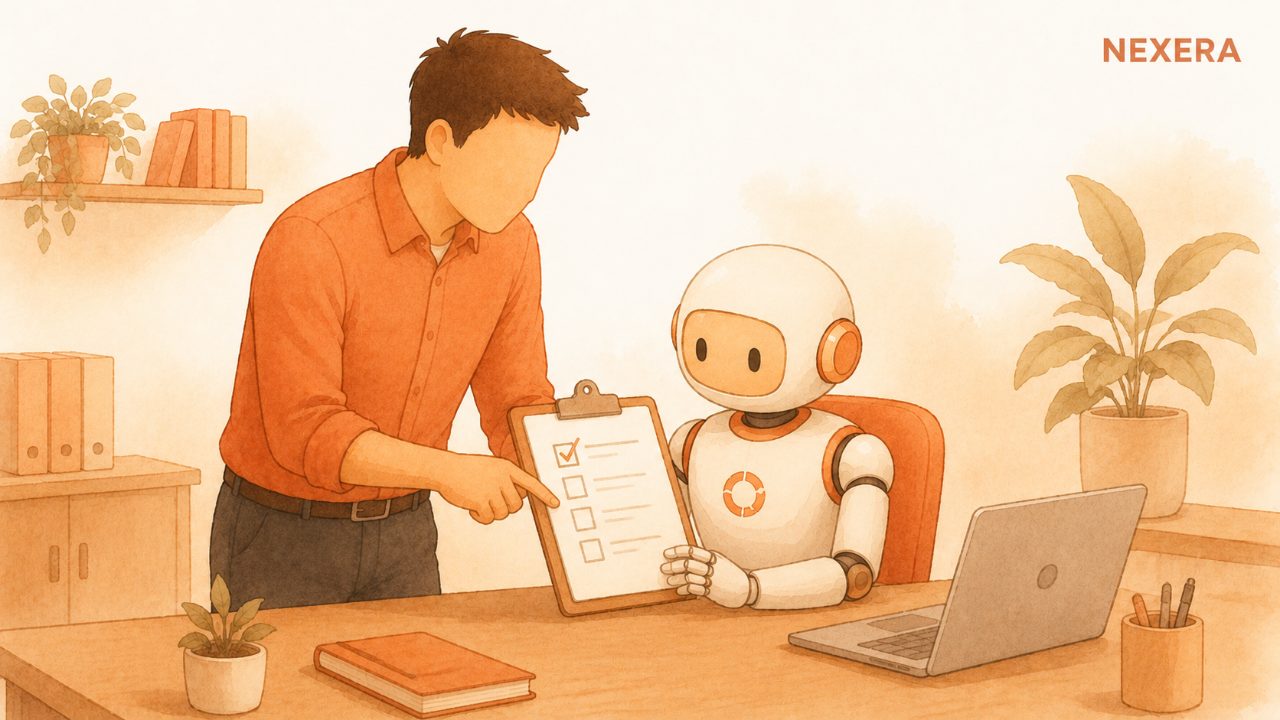
This is the reframe that fixes most of it. An agent is not a switch you flip. It is a worker you hire. And you already know how to bring on a worker.
You do not hand a new employee the keys to the bank account on day one. You give them one clear job. You show them where the edges are. You check their work for a while. And as they prove they can be trusted, you widen the lane.
Do the exact same thing with an agent.
Start with one narrow task, not your whole back office. Pick something with a clear right answer, like drafting follow-up emails or sorting incoming requests, and stay away from anything where a mistake is expensive and hard to catch. Put a fence around it, so it can draft but not send, suggest but not spend. Then keep a person in the loop reviewing the output until the agent has earned the right to run on its own.
That review period is not a lack of trust. It is how trust gets built, with a tool the same way it does with a person.
What this looks like on a Tuesday
One of my clients runs a small services firm. They told me they wanted an agent for "operations," which meant nothing and everything at the same time. So we started with a single job. Every night, the agent reads the day's new inquiries, drafts a tailored reply to each one, and drops them in a folder for a person to approve in the morning.
For three weeks, someone read every draft before it went out. They fixed the tone here, caught a wrong price there. By the fourth week the drafts were landing right almost every time, and the morning review took ten minutes instead of an hour. Now they are widening the lane and letting it handle scheduling too.
No transformation. No switch. Just a new hire that got good at one thing, then earned the next.
If you are being pitched an agent right now, that is the whole game. Make the vendor prove it is real before you pay. Then treat the real one like the newest member of your team, not a magic box. Give it one job, watch it closely, and let it earn the rest.
The businesses that win with agents this year will not be the ones who bought the most of them. They will be the ones who onboarded the few they kept.
If you are staring at one of these pitches and cannot tell what is real, that is exactly the kind of thing we work through with clients at nexeraintelligence.com. No pressure, just a straight answer.
Want one of these every other week?
Field notes from active Nexera engagements. No newsletter theater, no growth-hacks. Drop a line on a 30-min consult and we will add you to the rare-send list.