
Oct 5, 2026 - 6 min read
Your Customers Can Tell AI Wrote It
LinkedIn members flagged posts as AI slop more than a million times in about two weeks. Your customers read your emails with the same eye.

On July 30, LinkedIn added a new option to the menu on every post. It reads "seems like AI slop."
About two weeks later, the company's chief product officer said members had used it more than a million times.
That number got the headlines. The quieter move says more. In the same announcement, LinkedIn said it was retiring its own AI feature, the one that offered to rewrite your post for you, and replacing it with a proofreader. The platform that built an AI rewrite button took it away in the same breath it asked members to report AI slop.
If you run a business, this is about more than one social network.
A million people noticed
Start with what the readers did. Nobody had to teach LinkedIn members what AI writing looks like. They already knew it when they saw it, and they were irritated enough to open a post's menu and say so, more than a million times over.
The supply side explains the mood. Pangram, a company that builds AI detection software, scanned about a million posts across five platforms between late April and the end of June. On LinkedIn, more than 40% of the long-form posts in its sample read as fully AI-generated, the highest of any platform it looked at. Across everything it scanned on Reddit, the figure was under 5%.
The sample came from people who chose to install Pangram's browser extension, and no detector is perfect, so treat the exact figure as directional. The direction matches what your own feed already told you.
So that is the picture. Roughly four in ten long posts were written by a machine, and the people reading them started pushing back.
Your customers read your emails the same way
The person scrolling LinkedIn at lunch is the same person who opens your estimate follow-up at four o'clock. They did not leave that instinct behind.
Say you run a kitchen remodeling company and you just walked a house in Montclair. Two versions of the follow-up could go out that night.
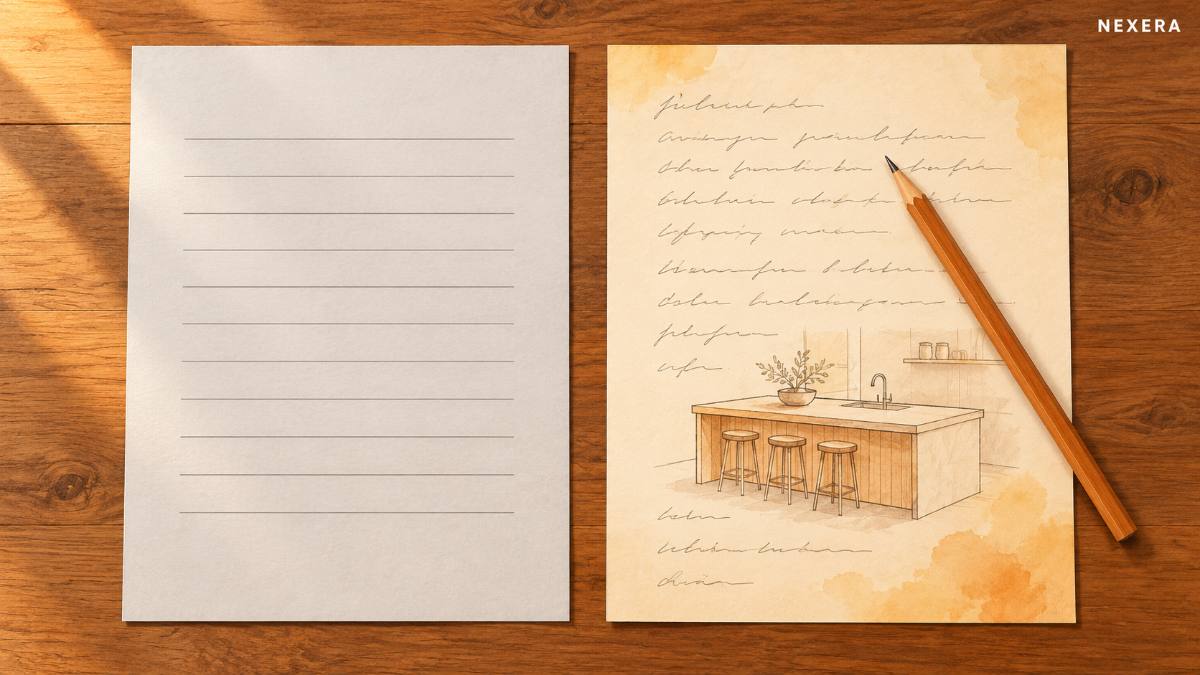
The first one opens by hoping the message finds them well. It thanks them for the opportunity, says your team is committed to delivering exceptional results, and invites them to reach out with any questions.
The second one says: "Hi Dana, I priced the version with the island moved to the window wall, like you asked. It adds $1,400 and about two days. The plumber can make it work, but the gas line is the part I would want you to see before you decide."
The first email could have been sent by any contractor to any homeowner in the country. The second could only have come from someone who stood in that kitchen. Dana may not be able to explain the difference, but she feels it right away. One of those companies was paying attention to her house. The other one was processing a lead.
Notice that the second email is not better written. It is shorter and plainer. What it has is information nobody else could have supplied.
What actually gives it away
People like to trade lists of tells. Certain words, certain punctuation, the tidy three-part sentence. Those lists go stale fast, because the tools change every few months.
The tell that does not change is emptiness. An AI model writes by predicting the most likely next thing to say, which makes it very good at producing the average of everything it has read. Give it nothing specific and it hands the average back, in perfect grammar. No address, no number, no name, no opinion you would have to defend.
For most of business history that kind of smooth, correct writing was hard to produce, so it read as effort. Today every one of your competitors has the same writer on staff, working around the clock. Smooth is now the cheapest thing in the inbox. Specific is what is scarce.
Make AI the editor, not the author
This is where LinkedIn's swap is worth copying. The feature it removed took your draft and rewrote it. The one that replaced it, by LinkedIn's own description, suggests changes inline and leaves you to accept or reject them. Same technology, different job. It went from writing for you to checking your writing.
I use AI on almost everything I write, and that is the arrangement that holds up. A few habits make it work.
Start with what you know. Before you open the tool, talk for a minute into your phone about what you want this customer to understand. The price, the catch, the thing you noticed on site. Paste that in and ask the AI to tidy it up and keep your wording. You get your own email back, minus the rambling.
Show it how you sound. Save three or four emails you wrote yourself and were happy with, and hand them over as the example every time. The output moves toward you and away from the average.
Cut the first line and the last line. That is where the filler collects. The greeting that says nothing and the sign-off that offers to answer any questions can almost always go.
Read it out loud once. If you would not say it across the counter, it should not go out under your name.
And be honest about where none of this matters. Appointment reminders, order confirmations, shipping notices, the internal summary of a long thread. Let AI write those start to finish. Nobody wants personality in a delivery window. Save your own voice for the messages where the customer is deciding whether to trust you: the proposal, the apology, the reply to the person who is upset, the note after a first meeting.
The writing got cheap. Being there did not.
AI did make writing easier, and I would not give that back. A blank page costs less than it used to, and people who dreaded writing can now get a clean message out the door in two minutes. That is a real gain for a small team.
What changed is what the reader is checking for. They used to look for whether you could write a professional email. Now everyone can, so they look for signs that a person who knows their situation was involved. A million reports on one button is a fairly clear vote on how they feel when the answer is no.
The fix costs nothing. Put in the details only you have, and let the machine clean up after you.
If your team has started leaning on AI for customer emails and proposals and it is all beginning to sound the same, that is something we work on with clients at Nexera Intelligence. Happy to take a look at how you are using it.
Want one of these every other week?
Field notes from active Nexera engagements. No newsletter theater, no growth-hacks. Drop a line on a 30-min consult and we will add you to the rare-send list.