
Mar 28, 2026 - 6 min read
The Real Cost of "We've Always Done It This Way" - How Manual Processes Are Bleeding Your Business Dry
Every business owner has heard it. Maybe you have said it yourself. "We have always done it this way." It is the most expensive sentence in business - not because the process is...
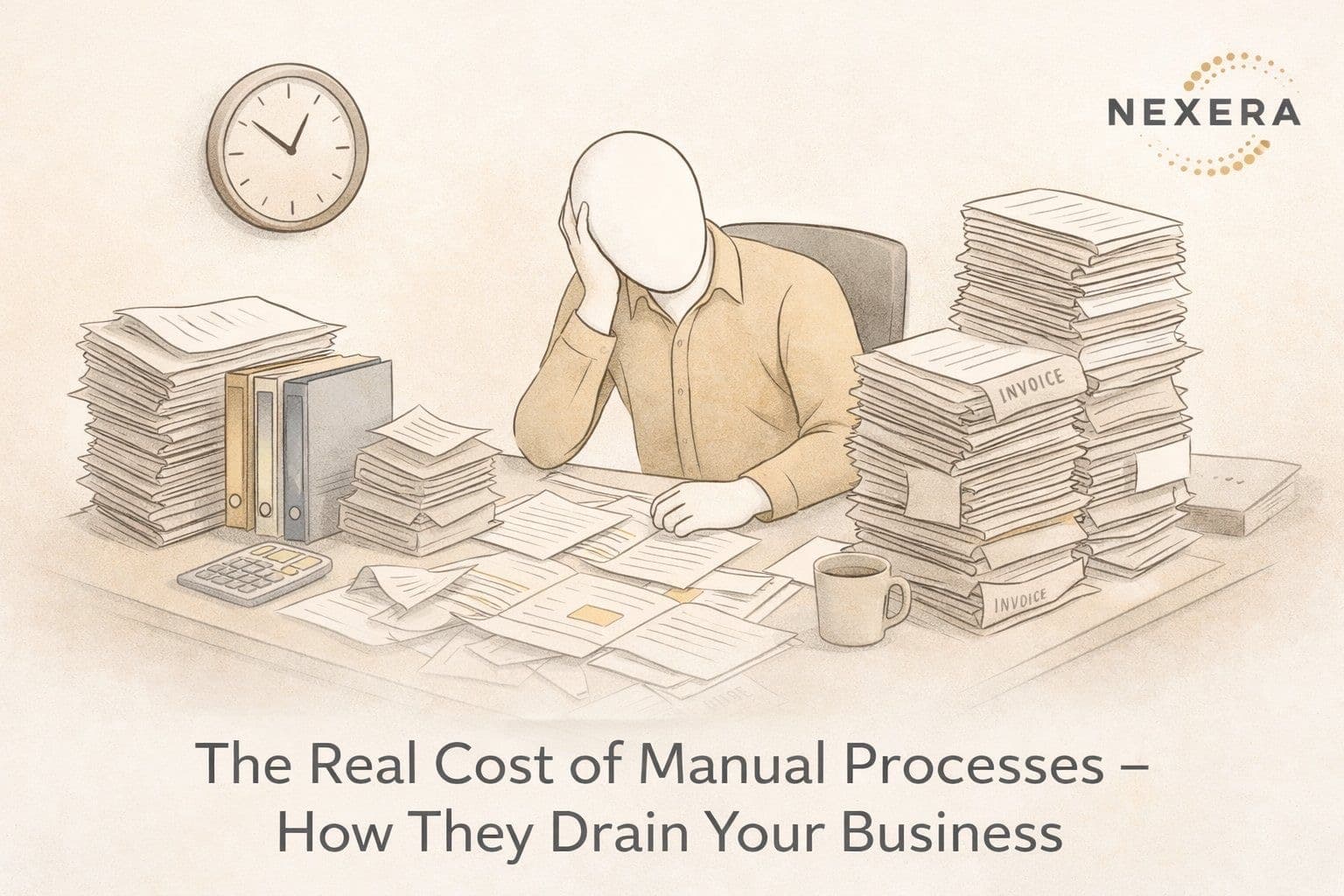
Every business owner has heard it. Maybe you have said it yourself. "We have always done it this way." It is the most expensive sentence in business - not because the process is wrong, but because no one has stopped to ask whether it still makes sense.
At Nexera Intelligence, we work with small and mid-sized businesses across the country to identify where manual processes are quietly draining time, money, and morale. What we have found is consistent: most companies are losing 30 to 40 percent of their team's productive hours to tasks that could be partially or fully automated.
Here is what that actually looks like - and what you can do about it.
Where the Time Actually Goes
When we run an AI Readine
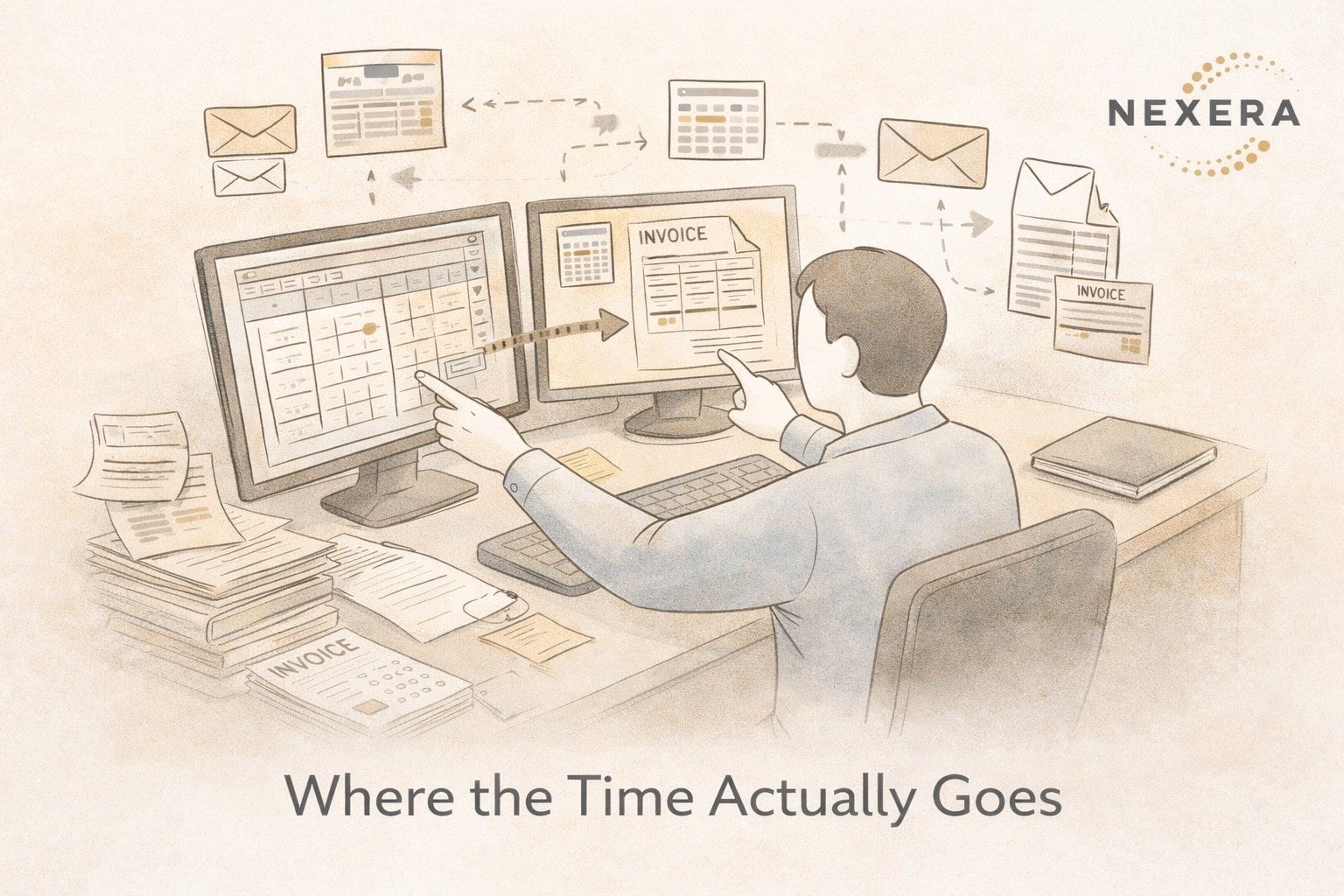
ss Assessment for a new client, we start by mapping every workflow that involves repetitive manual steps. The results are almost always surprising to the business owner.
Here are the most common time drains we see across industries:
Data entry and re-entry. Information gets typed into one system, then copied into another, then reformatted for a third. A single customer record might get manually entered four or five times across different platforms.
Email triage and routing. Someone on your team is spending hours every day reading incoming emails, figuring out who should handle them, and forwarding them along. Most of this can be handled by AI in seconds.
Invoice and payment processing. Matching invoices to purchase orders, verifying amounts, entering data into accounting software, and chasing approvals. For many businesses, this is a full-time job that adds zero strategic value.
Report generation. Pulling data from multiple sources, formatting it in spreadsheets, creating charts, and distributing reports. If your team is spending Friday afternoons building the same weekly report, that is a clear automation opportunity.
Scheduling and coordination. Back-and-forth emails to find meeting times, manually updating calendars, and coordinating between teams. This is death by a thousand small tasks.
The Math Most Business Owners Have Never Done
Let us run a quick calculation. Say you have a team of 15 people, and each person spends an average of 90 minutes per day on repetitive tasks that could be automated. That is conservative - most studies put it higher.
15 employees x 1.5 hours per day x 250 working days per year = 5,625 hours per year.
At an average fully loaded cost of $45 per hour, that is $253,125 per year spent on work that a machine could handle faster, more accurately, and without getting tired or frustrated.
That is not a rounding error. That is a full-time salary for three to four employees - or the budget for your next product launch, office upgrade, or hiring push.
And this does not account for the indirect costs: errors that require rework, slower customer response times, employee burnout from monotonous work, and the opportunity cost of not having your best people focused on strategy and growth.
Three Signs You Are Ready for AI Automation
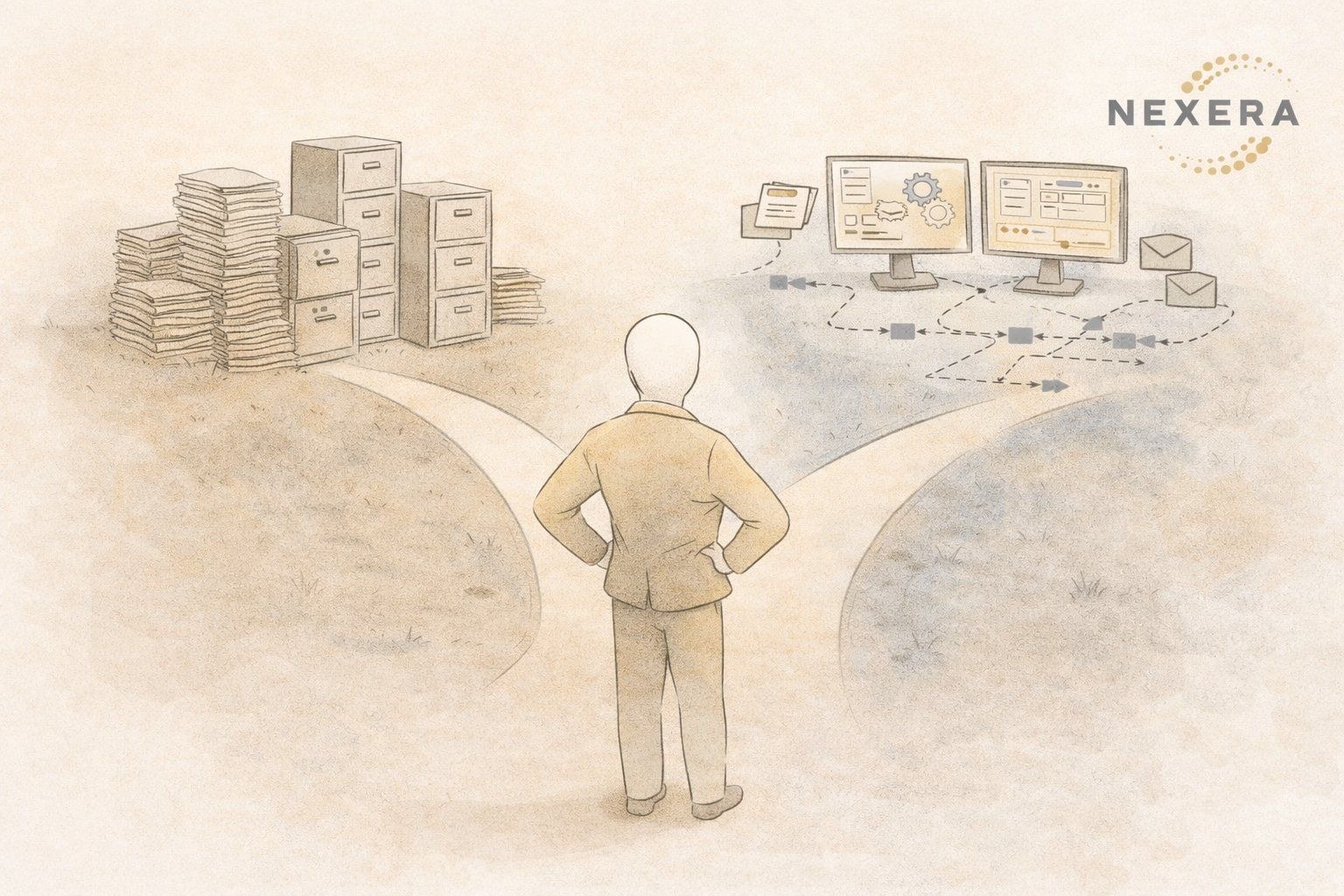
Not every business is ready to automate, and not every process should be automated. Here is how we help clients figure out where to start.
Sign 1: You have processes that follow predictable patterns. If a task has clear rules - "when X happens, do Y" - it is likely a strong candidate for automation. Invoice processing, data validation, email categorization, and document filing all fall into this category.
Sign 2: Your team is doing the same thing more than 20 times per week. Volume matters. Automating a task you do twice a month will not move the needle. But automating something your team does 50 or 100 times per day? That is where the ROI gets serious.
Sign 3: Errors in the process have real consequences. Manual data entry has an average error rate of 2 to 5 percent. If those errors lead to billing mistakes, compliance issues, or customer complaints, automation pays for itself in risk reduction alone.
What AI Automation Actually Looks Like in Practice
There is a lot of hype around AI, so let us be specific about what works today for small and mid-sized businesses.
Intelligent document processing. AI can read invoices, contracts, forms, and emails - extracting the data you need and putting it directly into your systems. No more manual data entry for structured documents.
Smart email and message routing. AI categorizes incoming communications by intent, urgency, and topic, then routes them to the right person or triggers the right workflow automatically.
Automated reporting and dashboards. Instead of someone building reports manually, AI pulls data from your systems on a schedule and generates formatted reports - or better yet, live dashboards that update in real time.
Workflow orchestration. When a new client signs up, AI can trigger the entire onboarding sequence: sending welcome emails, creating accounts in your systems, scheduling kickoff calls, and assigning tasks to team members.
The Approach That Actually Works
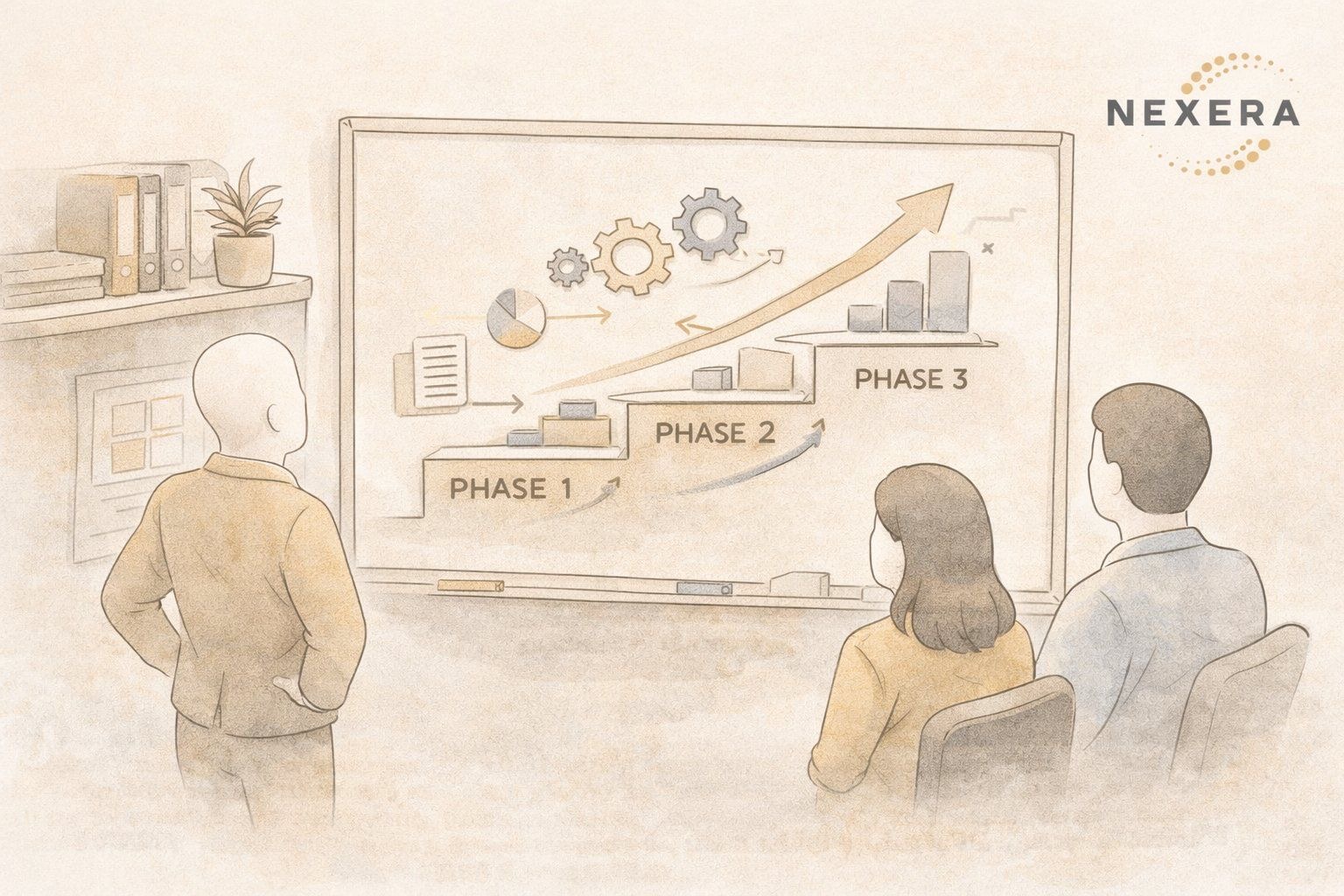
We have seen businesses try to automate everything at once. It almost never works. The teams that get the best results follow a phased approach:
Phase 1: Audit and prioritize (1-2 weeks). Map your workflows, measure the time spent, and calculate the potential ROI for each automation opportunity. Start with the highest-impact, lowest-complexity wins.
Phase 2: Quick wins first (2-4 weeks). Implement the automations that deliver immediate, visible results. This builds team confidence and executive buy-in for larger projects.
Phase 3: Scale what works (ongoing). Once the foundation is in place, expand automation across more processes and departments. Each successful automation makes the next one easier to justify and implement.
The Bottom Line
The businesses that will thrive over the next five years are not the ones with the biggest teams or the largest budgets. They are the ones that figure out how to multiply their team's output by eliminating the work that should not require a human in the first place.
If you are curious about where your business stands, we offer a free AI Readiness Assessment. We will map your workflows, identify the biggest opportunities, and give you a realistic roadmap for what automation can do for your specific situation.
Ready to stop paying people to do a machine's job? Book a free consultation and let us show you what is possible.
Want one of these every other week?
Field notes from active Nexera engagements. No newsletter theater, no growth-hacks. Drop a line on a 30-min consult and we will add you to the rare-send list.